
Collection of paintings
This artistic project has been evolving since April 2023. The artist devotes her free time to creating new paintings, all of which are autobiographical and intended to raise awareness. Having had the opportunity to meet numerous specialists and doctors since 2015, she decided to paint her reflections, realizations, and lessons learned from her experiences. In this way, she shares her “legacy of life.”
All the paintings are interconnected and form a “whole”: a multidisciplinary team. However, the Dolores exhibition will be distributed across different waiting rooms. Each painting is created to work in correlation with another painting displayed in the same waiting room. The works are therefore organized by “specialty.” A collection for a medical practice consists of at least two paintings so that the message can be fully conveyed. Each painting is accompanied by an explanatory text.
Please note that the artist has no medical qualifications; her work reflects a personal perspective and experience. Where appropriate, healthcare professionals may use Dolores’s paintings to help illustrate or support their discussions with patients.
Quick access to different themes
The Dolores exhibition is built around three values: health, compassion, and love.
The artist creates bespoke exhibitions and projects for medical organisations, businesses and universities.
The artist also creates custom commissions for both professionals and private individuals. Through Dolores’s experiences and perspective, she conveys the messages you wish to communicate.
Anyone interested in this artistic project is welcome to contact the artist.
Chronic pain
Paintings created for patients at the Bron Pain Management Centre
“The Centre for Pain Assessment and Treatment (CETD) provides care for chronic pain that has not responded to conventional treatments available at other centres.”
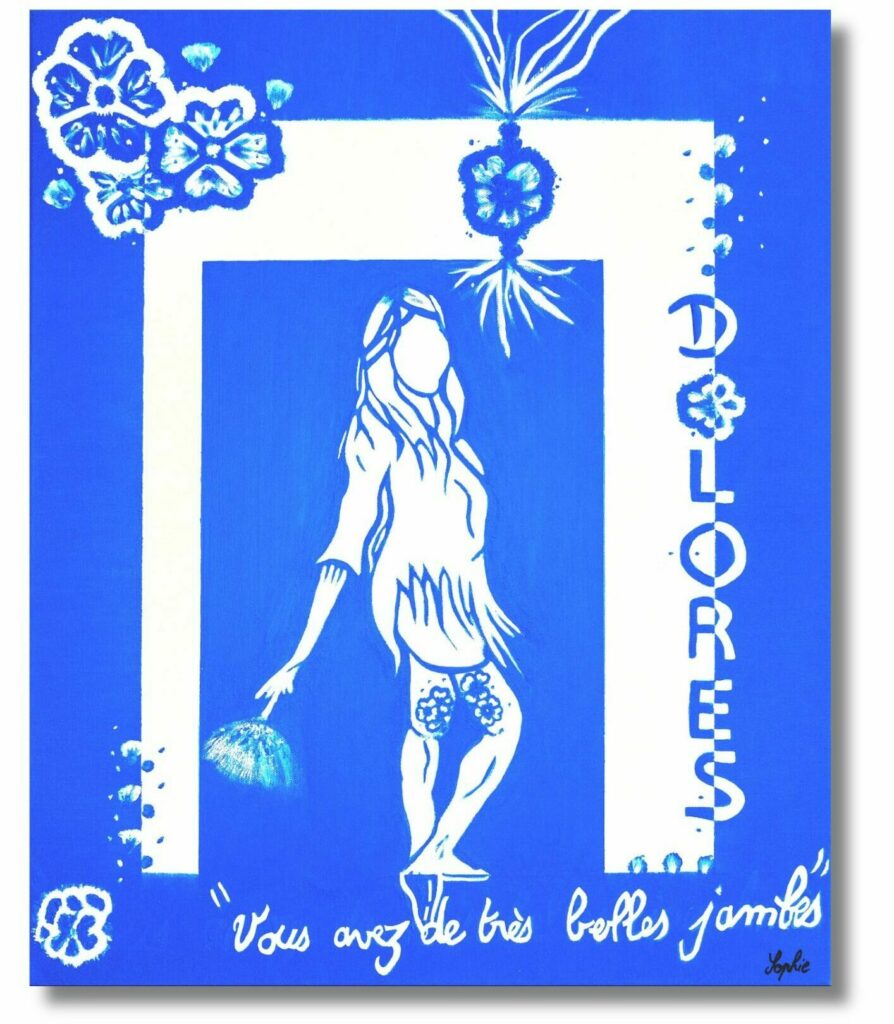
Painting, 73 x 60 cm
April 2023
Dolores
Text accompanying the painting:
Pain is remembered and stored by the nervous system through sensation, thoughts, and emotions. Becoming aware of this process can help create opportunities to act on and manage pain. In the painting, pain is represented by the flowers: the thoughts. Thoughts are transmitted through the nerves and can amplify pain.
Read more
Well-intentioned compliments related to a patient’s appearance or perceived well-being may be poorly received by someone living with chronic pain. Beauty does not exclude pain, just as invisibility does not mean non-existence. Chronic pain can trap a patient in suffering when it is not properly addressed and managed.
“Dolores” means “pains” in Spanish
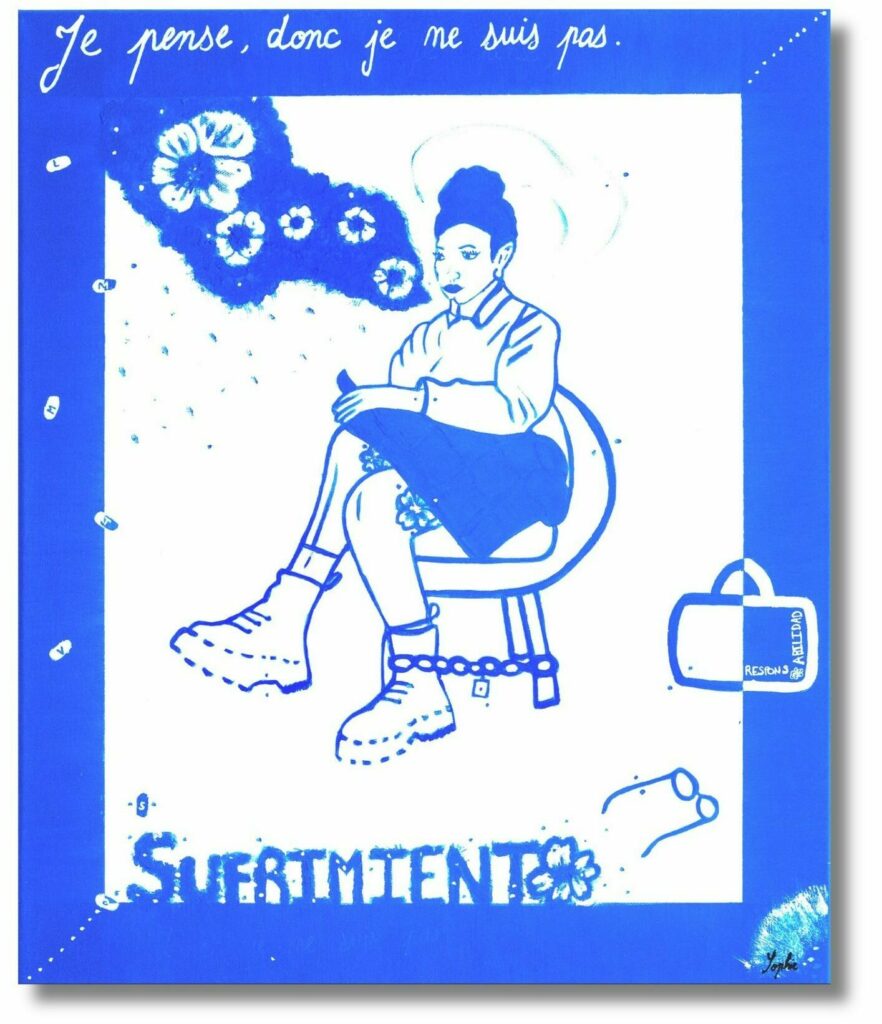
Painting, 65 x 54 cm
April 2023
Sufrimiento
Text accompanying the painting:
Medical uncertainty and a prolonged search for answers can lead to a feeling of hopelessness and depression. Prevention may involve consulting a psychologist or psychiatrist. Pain can cause psychological suffering. Psychotherapy and a consistent meditation practice can help reduce, or even alleviate, the psychological suffering associated with pain. As a result, pain may become more manageable.
“Sufrimiento” means “suffering” in Spanish.
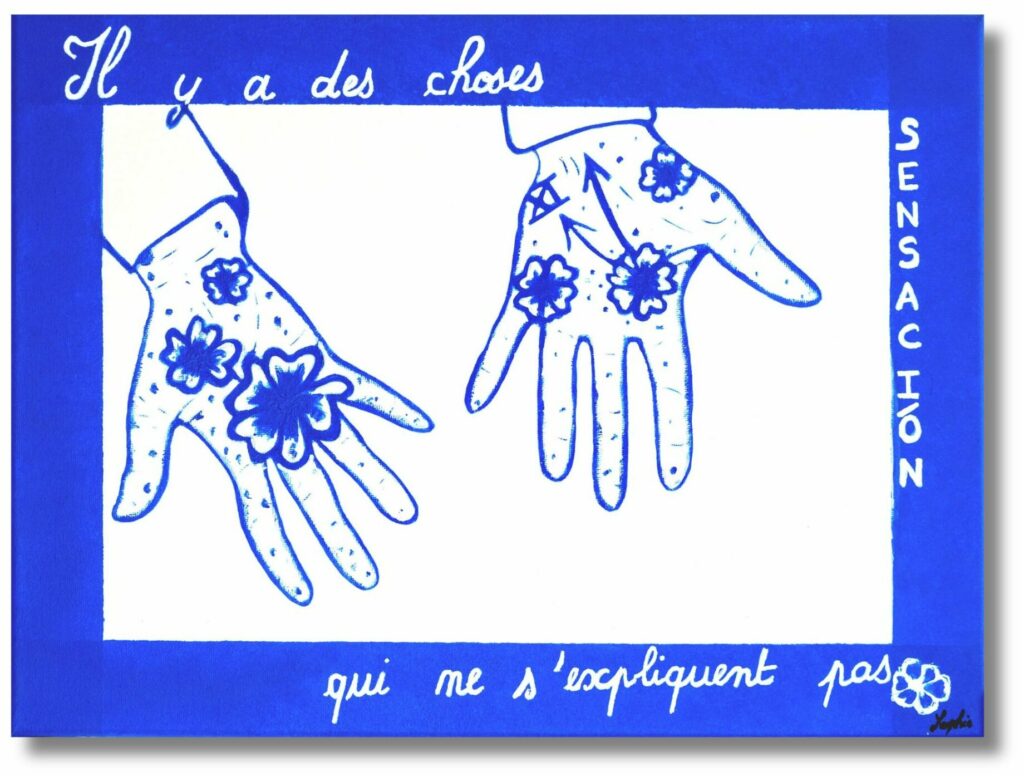
Painting, 30 x 40 cm
April 2023
Sensación
Text accompanying the painting:
There are pains that cannot be explained. Dolores experiences sensations such as tingling and itching in the palms of her hands. This symptom occurs almost every evening, always at the same time: 11:00 p.m. Not everything can be explained. It is possible to seek support from a qualified professional to help with the process of acceptance.
“Sensación” means “sensation” in Spanish.

Pain Assessment and Treatment Centre (CETD) at Pierre Wertheimer Hospital in Bron, since April 2023
Invisible Disability
Art project created for FIDEV in Lyon
“FIDEV (Training, Integration and Rehabilitation for People with Visual Impairments) comprises three areas of activity: a post-acute care and rehabilitation service for adults with visual and/or hearing impairments, a training service, and a technical support service to help people access and remain in employment.”
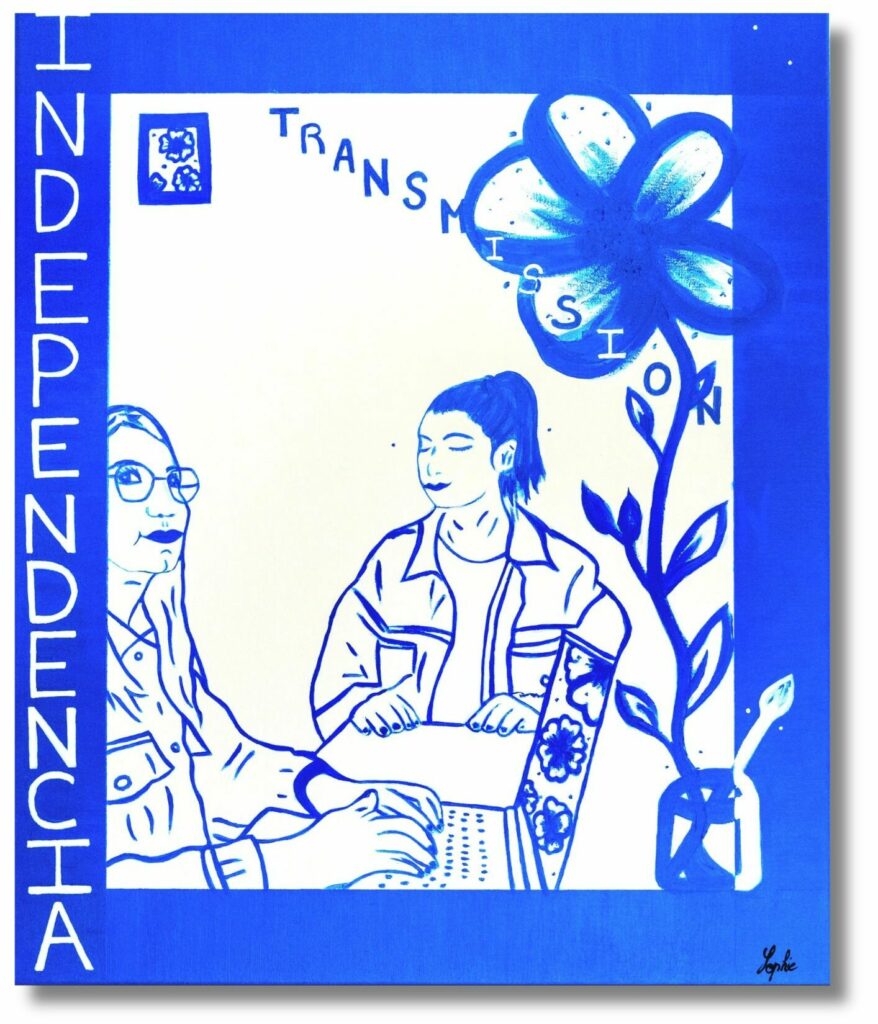
Painting, 60 x 50 cm
April 2023
Independencia
Text accompanying the painting:
Thank you to the FIDEV team, who support patients in adapting their workstations, developing their professional projects, and improving their quality of life. The staff genuinely put themselves in their patients’ shoes in order to provide them with the best possible support. FIDEV provides knowledge and training tailored to each patient’s specific needs and gives them an invaluable gift: a form of independence.
In the painting, Dolores is taking a touch-typing course to learn how to use a computer without having to look at the screen.
“Independencia” means “independence” in Spanish.
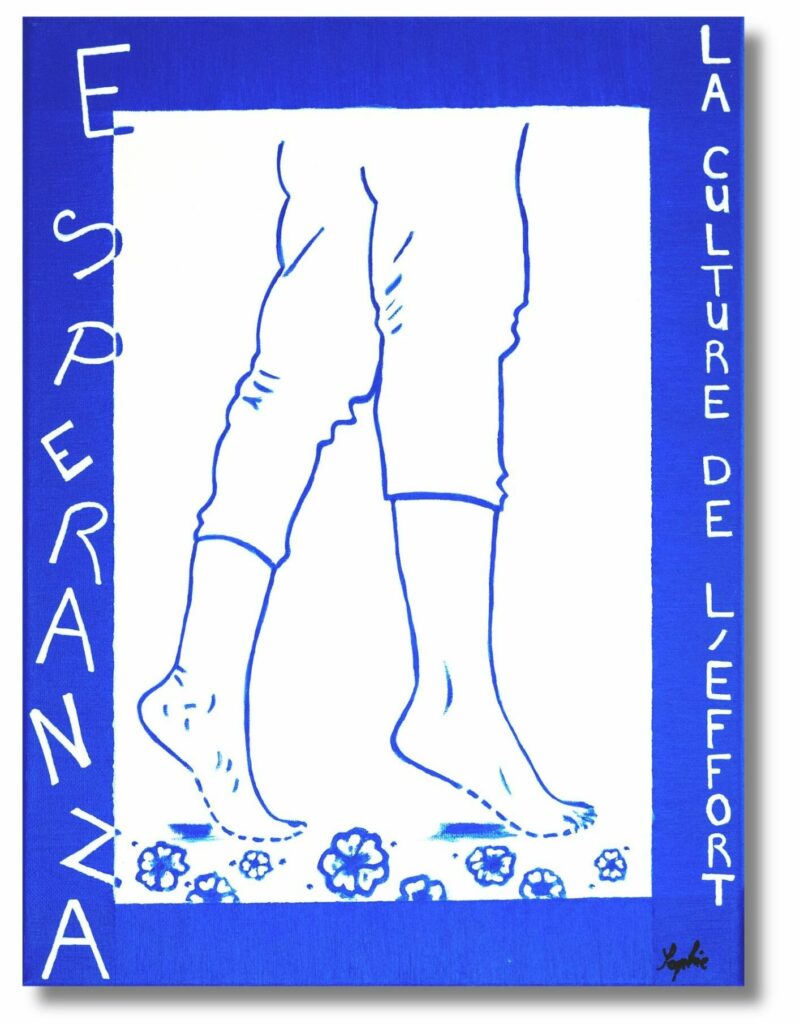
Painting, 30 x 40 cm
April 2023
Esperanza
Text accompanying the painting:
Dolores works on her proprioception disorder every day. She practices mirror therapy by looking at her feet in a mirror each day, helping her become aware of their existence and function. Dolores embraces a culture of perseverance and effort.
“Esperanza” means “hope” in Spanish.

FIDEV in Lyon 8th arrondissement, from April to June 2026
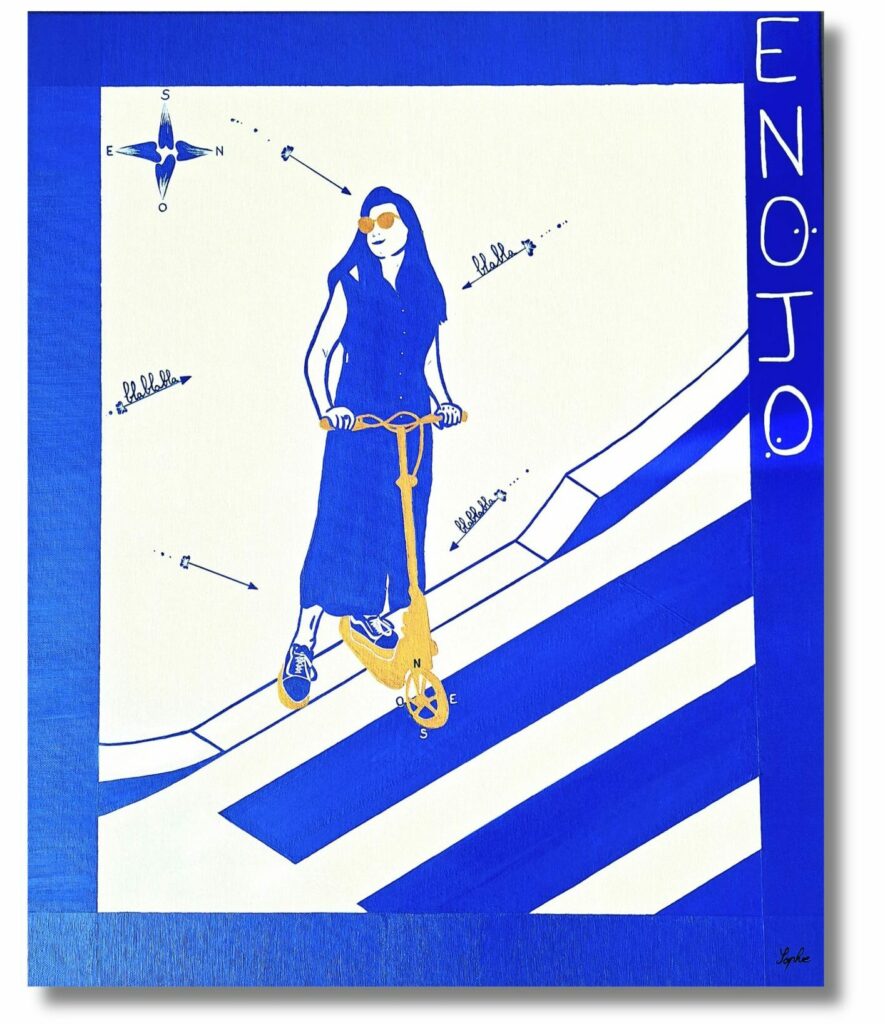
Painting, 73 x 60 cm
October 2025
Enojo
Text accompanying the painting:
This painting illustrates the complexity of living with an invisible disability.
Dolores uses a scooter as a walking aid. It enables her to get around more easily and travel longer distances. This mobility aid is essential to her ability to continue working. Many disabled people find alternatives to using a walking stick.
The artist has painted the equipment she needs to remain in employment in gold. It is invaluable to her, as it gives her independence.
The arrows on the canvas represent the comments and judgements of others, which can be hurtful.
In France, people with disabilities can benefit from RQTH, official Recognition of Disabled Worker Status.
According to the French government website: “Recognition as a disabled worker provides access to a range of measures designed to promote the employment of disabled people and help them remain in work.”
“Enojo” means “anger” in Spanish.
Mental health
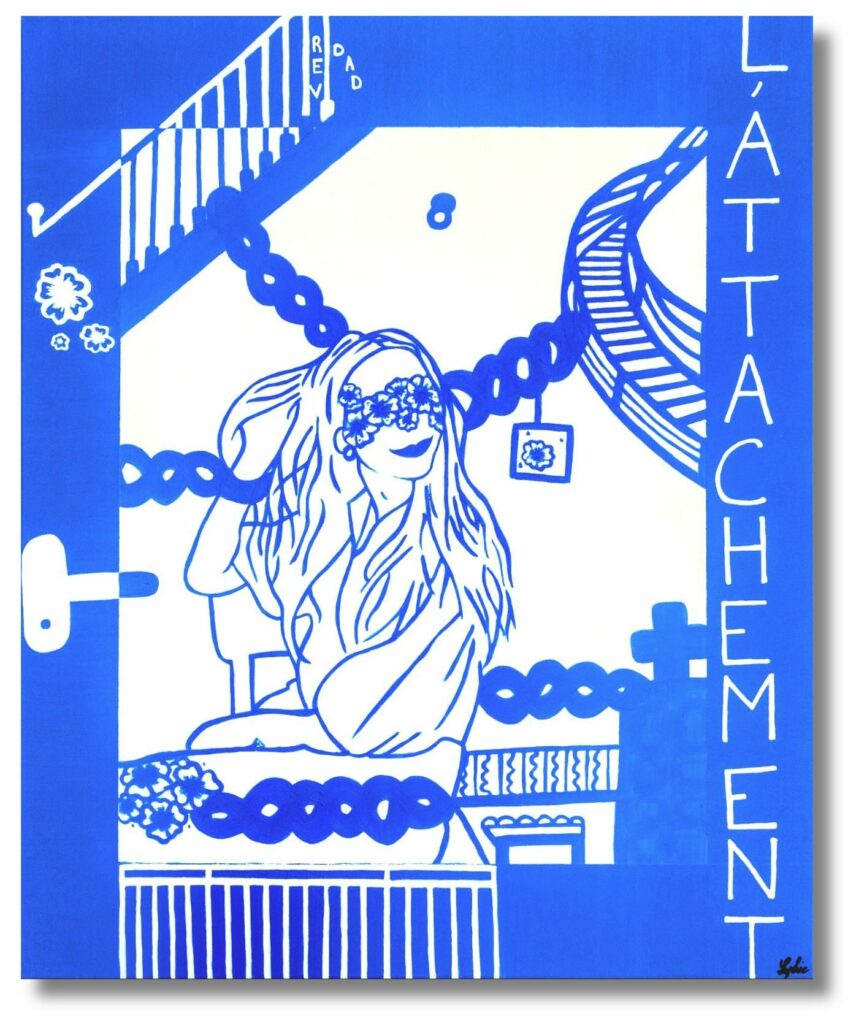
Painting, 73 x 60 cm
April 2023
L’attachement
Text accompanying the painting:
Sometimes, it is necessary to question our various attachments — to people, images, ideas, and so on. “What purpose does this attachment serve?”
Living without attachment does not mean living alone. Attachment can prevent us from leaving and from fulfilling our potential. Freedom allows us to leave and then return — if and only if the reason for returning is desire.
Psychiatric or psychological support can help us break free from certain attachments and, as a result, from the suffering they cause. Letting go takes time, but freedom awaits on the other side.
L’Attachement will be the only painting in the Dolores collection to have a title in French, so that its audience cannot avoid confronting its meaning. It is the artist’s favorite painting and represents the very essence of this collection.
“Verdad” means “truth” in Spanish.
“L’attachement” means “attachment” in French.
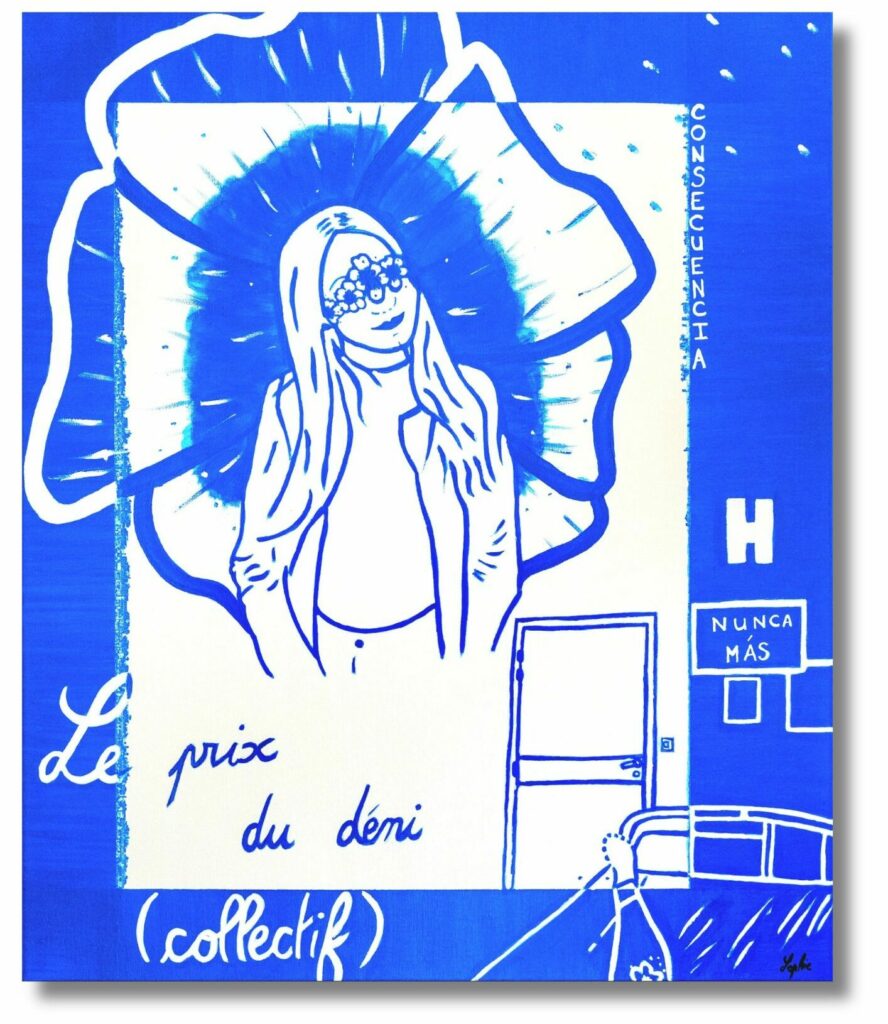
Painting, 60 x 50 cm
May and June 2023
Consecuencia
Text accompanying the painting:
Health comes first. Ignoring pain, suffering, or a toxic environment can have a significant impact on our health and, consequently, on our social, professional, emotional, and financial lives. A lack of appropriate care can lead to a considerable loss of independence and have dramatic consequences.
“Consecuencia” means “consequence” in Spanish.
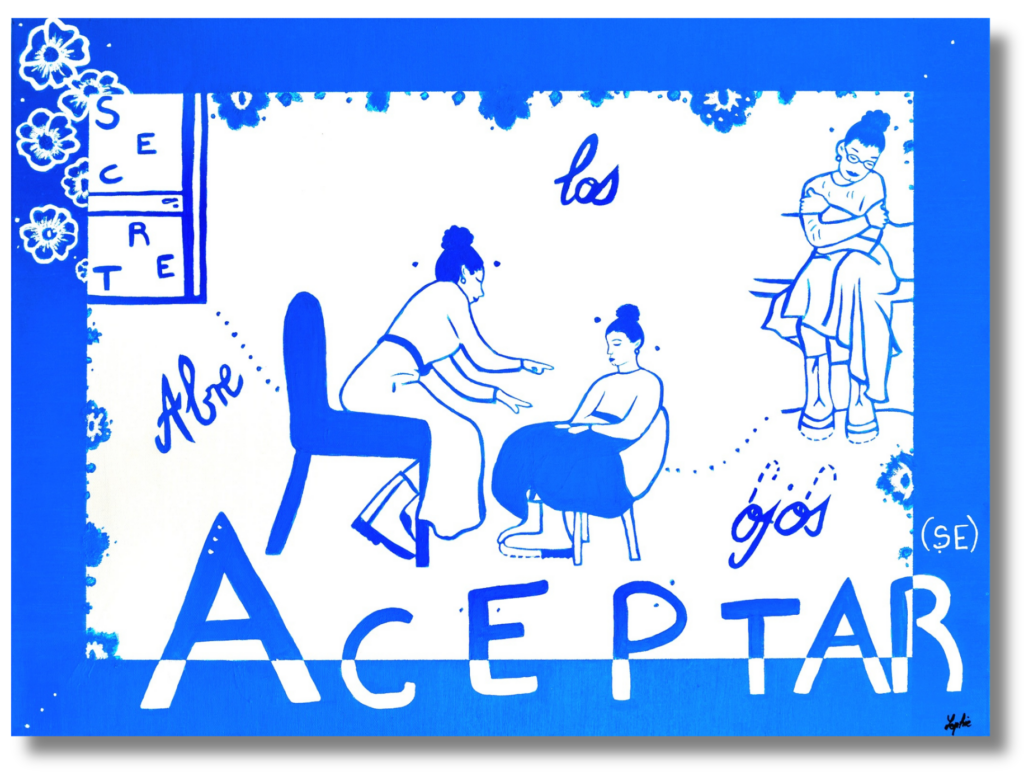
Painting, 54 x 73 cm
April 2023
Aceptar(se)
Text accompanying the painting:
This painting depicts one of Dolores’s EMDR sessions with a psychologist. In the painting, the psychologist and Dolores have the same physical appearance. This represents the idea that each patient has a responsibility to “save themselves.” To do so, they must make the decision to seek support from healthcare professionals. Their recovery will depend on their commitment and personal involvement. Personal work can be challenging, but it is necessary. The patient must learn to accept what feels unacceptable in order to move forward.
Read more
EMDR* sessions can be beneficial in the treatment of post-traumatic stress disorder (PTSD). They can help patients change certain patterns of thought and behavior.
A psychologist teaches the patient how to reassure themselves.
*Definition of EMDR (as published on the EMDR France website):
“This neuro-emotional mechanism, triggered by eye movements, makes it possible to process unresolved traumatic experiences that cause a range of symptoms, which can sometimes be severely debilitating. Traumatic after-effects can therefore be treated even many years later. EMDR therapy has been the subject of numerous international scientific studies. It is recognised as a treatment for post-traumatic stress disorder by the World Health Organization (WHO, 2013), the French National Institute of Health and Medical Research (INSERM, 2004 and 2015), and the French National Authority for Health (HAS, 2007).”
“Aceptar(se)” means “to accept oneself” in Spanish.
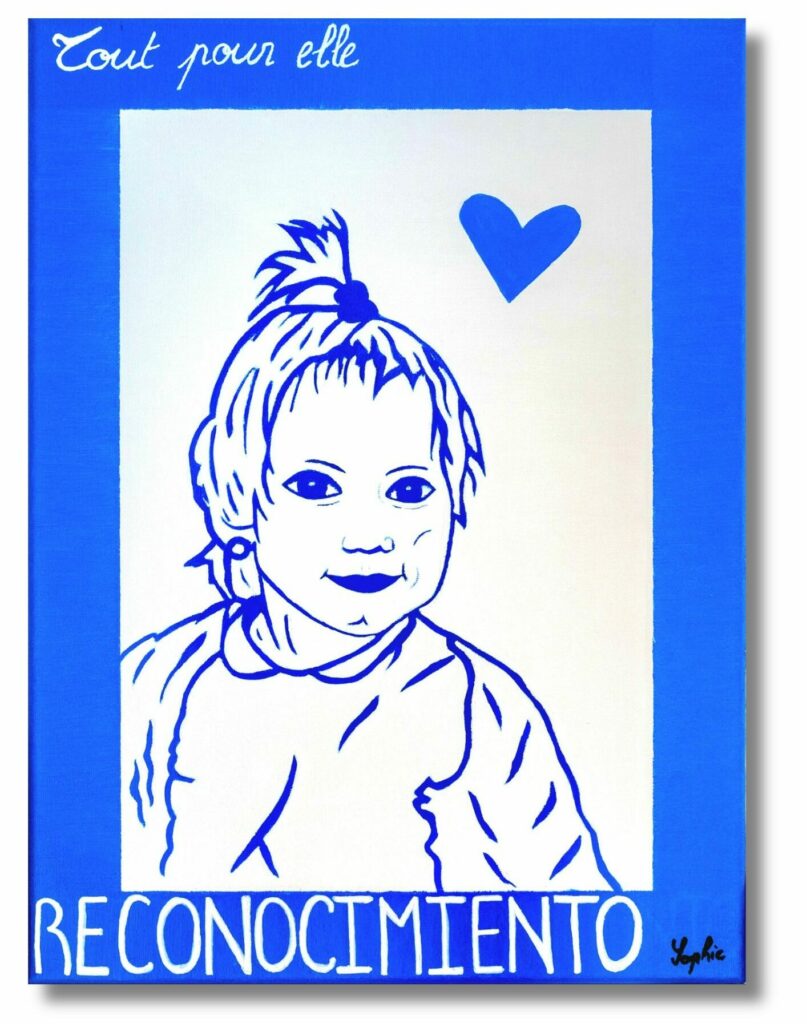
Painting, 30 x 40 cm
April 2023
Reconocimiento
Text accompanying the painting:
This is a photograph of Dolores as a child. The patient learns to acknowledge and honor their inner child. Everything they do is for the child they once were.
“Reconocimiento” means “recognition” or “acknowledgment” in Spanish.

Psychology practice in Lyon 6th arrondissement
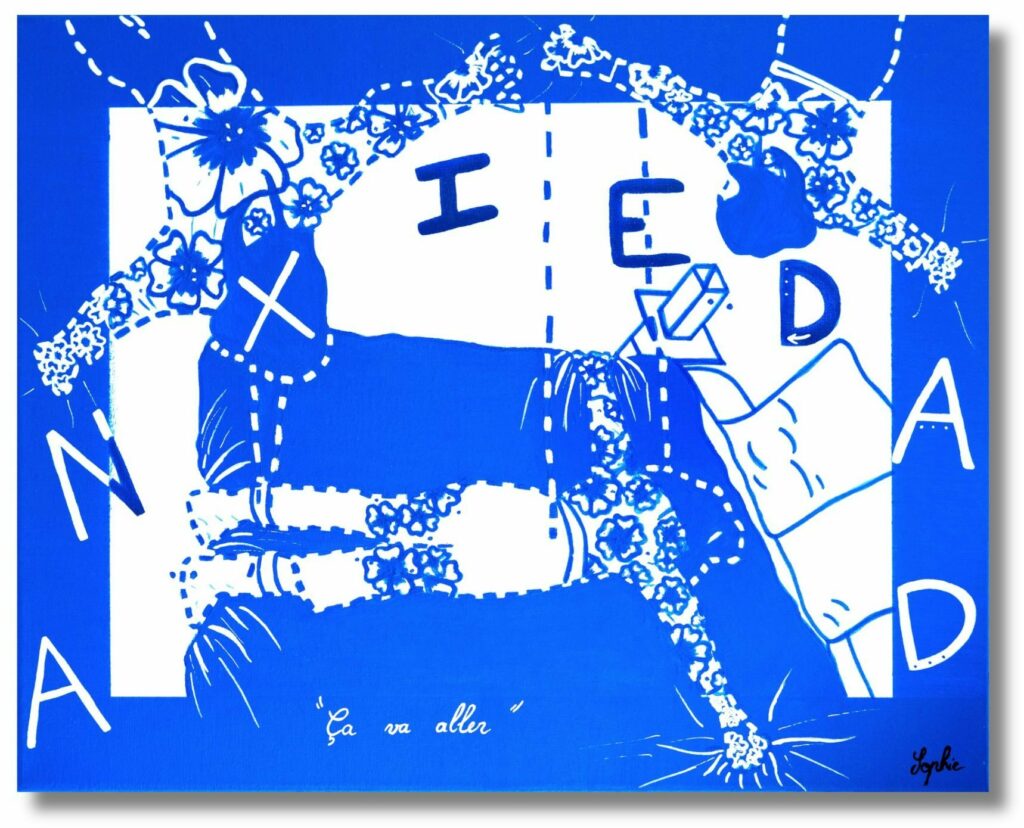
Painting, 40 x 50 cm
December 2023
Anxiedad
Text accompanying the painting:
It seems that she was born with Dolores. She had chosen a comfortable place and existed only through her body. Some say she was there to protect her. Dolores, however, knew that she was capable of destroying her. Always present in the middle of her abdomen, she never left her. Tangible and insatiable. She remained in this form for more than twenty years, reminding Dolores every day that she lived inside her. It was indeed she who dominated her.
Read more
It has now been three years since she decided to scream, without ever stopping. She opted for a new, more violent strategy: burning her own arms, then liquefying her body—making it seem as though she had died. She commanded her muscles to contract, ensuring that she could never find peace again.
She also took over every one of her nights. Between nightmares and hallucinations, she needed all of her attention. During the most unbearable moments, she made her leave her body to frighten her again and again. She settled into her life without asking for her permission. She never left. Dolores learned to live every second of her new life with her. Every day, she wants to believe that one day she will finally leave her. To let her simply be.
Never underestimate anxiety.
In this painting, Dolores depicts one of her dissociative episodes triggered by anxiety. These episodes occur during moments of extreme suffering.
She clings to the furniture (in this case, her bed) while feeling as though she is floating away. She sees herself outside her body and leaving it. She feels herself disappearing and dying, both physically and psychologically. It is vital to consult a psychiatrist as soon as these symptoms appear, in order to understand that this state has a medical explanation, can be controlled, and can be treated.
“Anxiedad” means “anxiety” in Spanish.
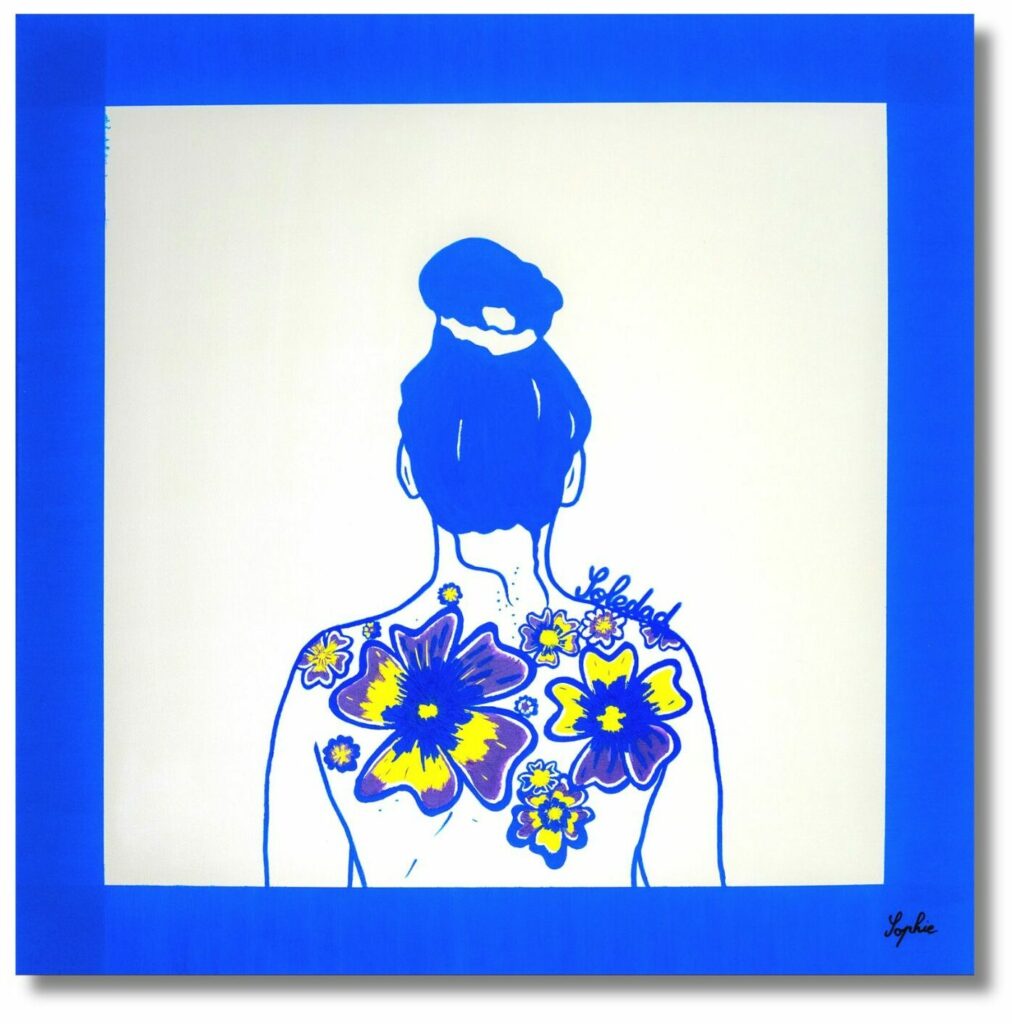
Painting, 60 x 60 cm
July 2024
Soledad
Text accompanying the painting:
An Ally in Anxiety.
“Soledad means “solitude” in Spanish.
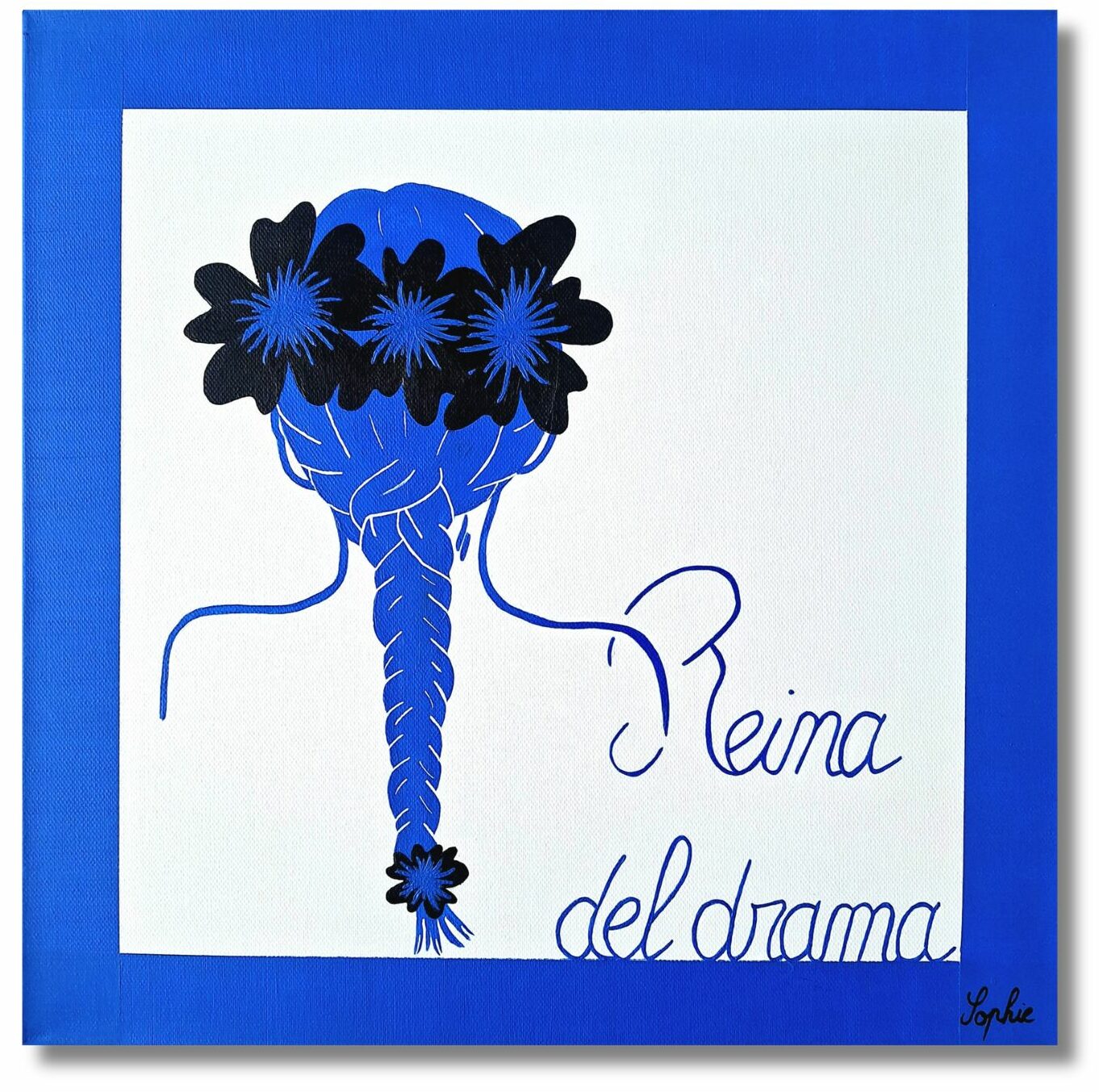
Painting, 40 x 40 cm
December 2024
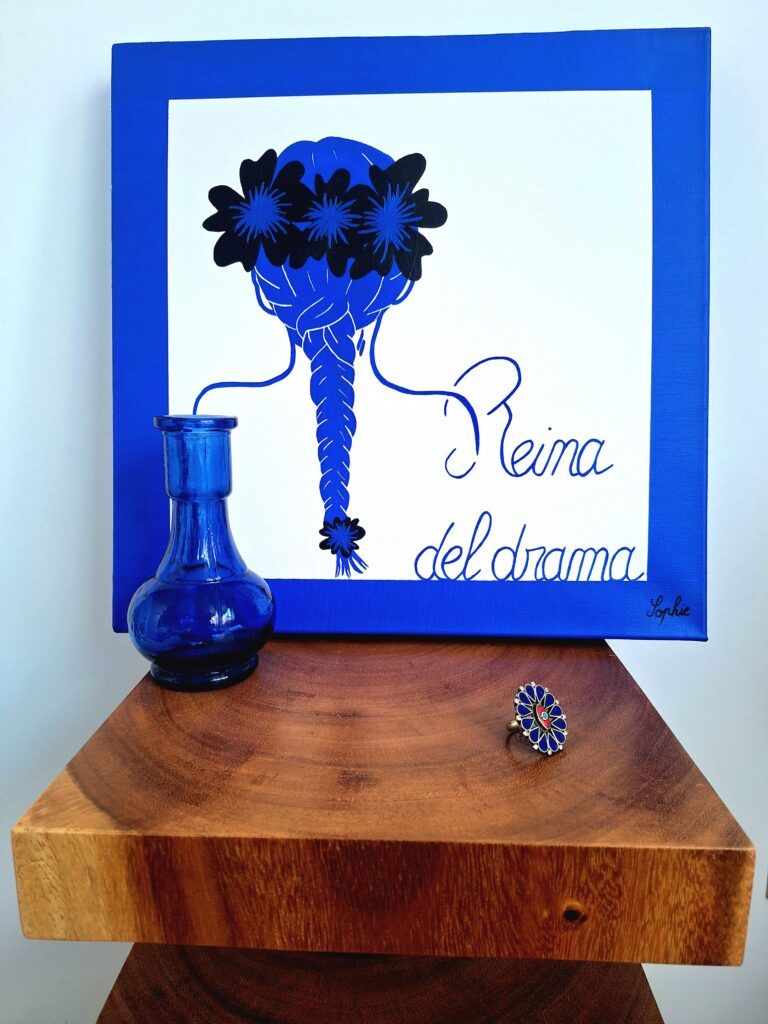
Reina del drama
Text accompanying the painting:
Dolores wears a crown of dark thoughts and intrusive, overwhelming fears of acting on unwanted impulses.
It is essential to understand that we are not our thoughts and that our thoughts do not define us. Daily meditation has helped her to detach herself from her “persona.” The intrusive and distressing thoughts are still there, but it is now much easier for her not to believe them.
Someone who is suffering may be stigmatised as a “Drama Queen.”
Read more
Some people use this “title” in the belief that they are being humorous or trying to make light of the situation. Depending on the context, the person may well be genuinely suffering, and this misjudgement may only serve to intensify their distress.
“Reina del drama” means “Drama Queen” in Spanish.

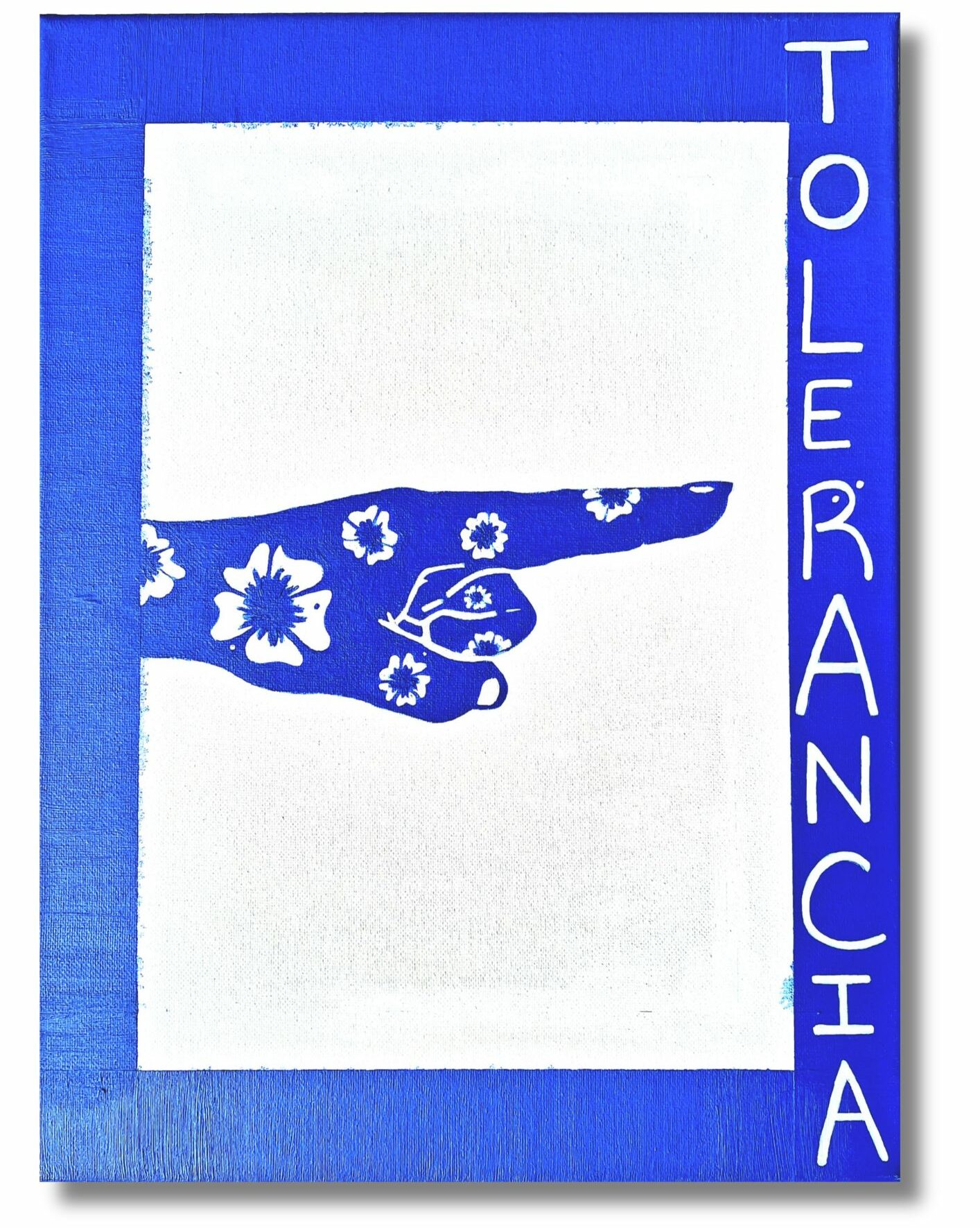
Painting, 30 x 40 cm
October 2025
Tolerancia
Text accompanying the painting:
“Tolerancia” means “tolerance” in Spanish.
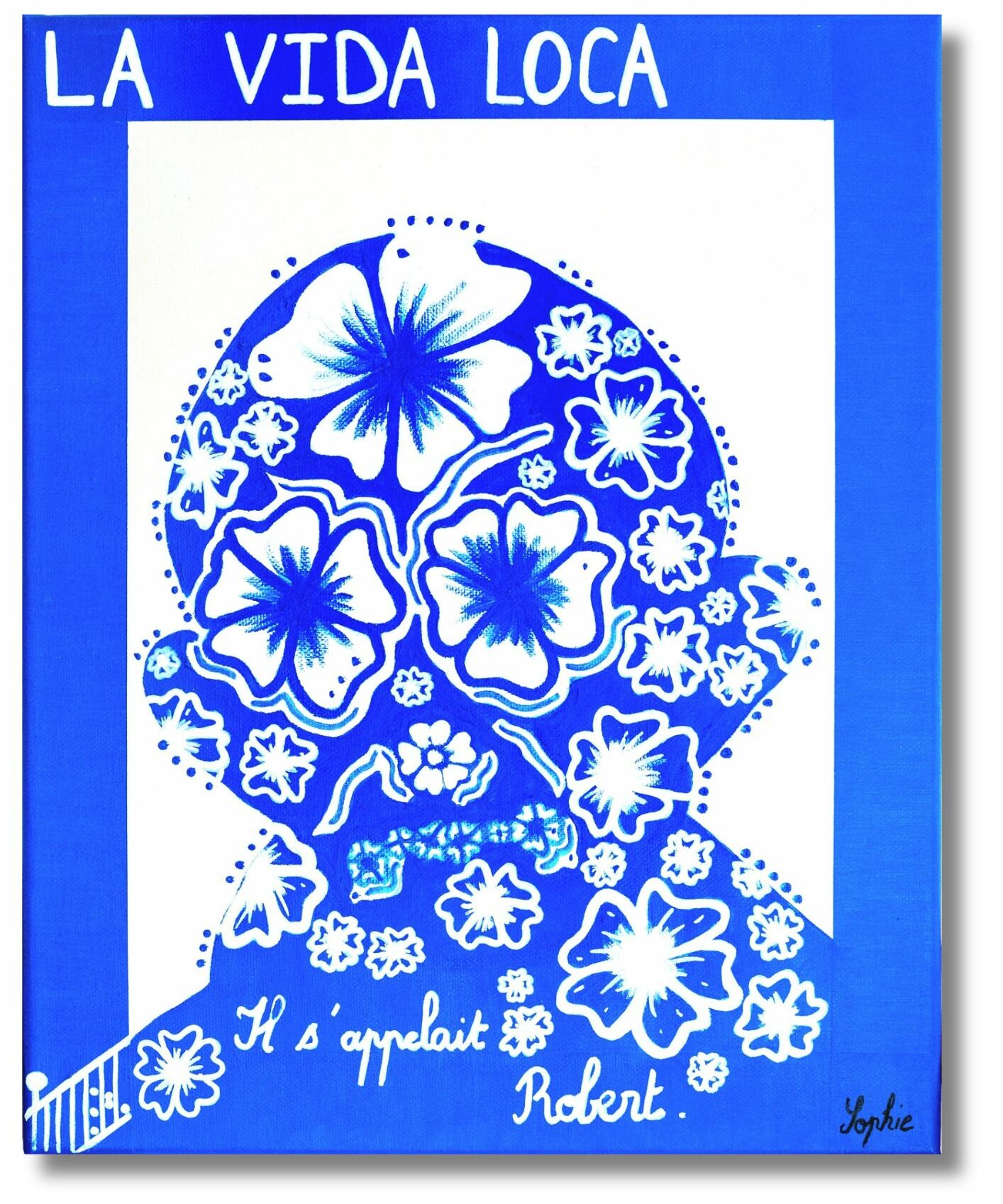
Painting, 33 x 40 cm
February 2024
La vida loca
Text accompanying the painting:
Psychiatric disorders are nothing to be ashamed of.
Psychiatry still unfortunately frightens society, which may feel threatened due to a lack of understanding of mental illnesses. Yet mental illnesses are among the third most common categories of health conditions. They can affect any of us at some point in our lives.
A sense of shame often affects the person who is suffering, but also those around them. They may experience misunderstanding, exclusion, rejection, and isolation from society.
Dolores questions the place of “madness” in these situations. Which side is it really on?
The artist particularly denounces family secrets and the serious consequences they can have on the person who is suffering (isolation, lack of or inadequate care, worsening symptoms, loss of identity and independence, lack of freedom, abuse), as well as on everyone around them (the consequences of a collective lie, anxiety).
It is necessary to provide care for those who are suffering, ensuring they receive treatment, support, and integration into society. Their rightful place is one free from prejudice and rooted in collective support.
“La vida loca” is a Spanish expression meaning “the crazy life”.
Violence against women
“If you need support, you can call +33 3919 (France) free of charge, 24 hours a day, 7 days a week, for all forms of gender-based violence, including domestic abuse, sexual violence, forced marriage, female genital mutilation and violence in the workplace. The service is available to victims, people close to them and the professionals concerned. This national helpline provides a listening ear and information and, depending on individual needs, refers callers to appropriate local support and care services.”
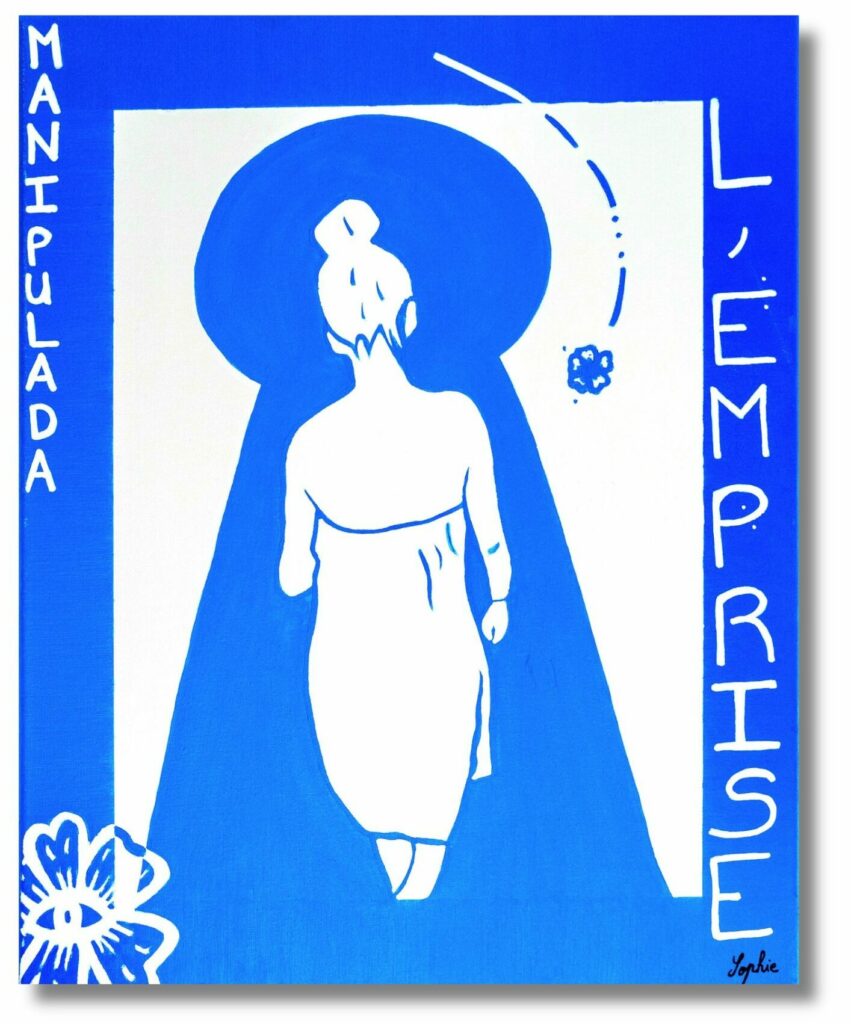
Painting, 40 x 50 cm
July 2023
Manipulada
Text accompanying the painting:
No one has the right to harass or mistreat you.
Dolores encourages everyone who has experienced physical or psychological abuse to speak out and seek support from professionals trained in this field. Choosing life means confiding in compassionate people who are able to listen, hear, acknowledge, understand, support, and help. Those around us may be well-intentioned but can unintentionally be clumsy or inappropriate in the words they use and the advice they give. Choosing the right words is essential to avoid causing further harm.
Recognizing oneself as a victim is the first step toward ensuring that one does not remain a victim in the future. There are many organizations whose very purpose is to help victims navigate difficult and dangerous situations. It is possible to “save yourself” safely. Responding to manipulation with manipulation is not the best strategy.
“Manipulada” means “manipulated” in Spanish.
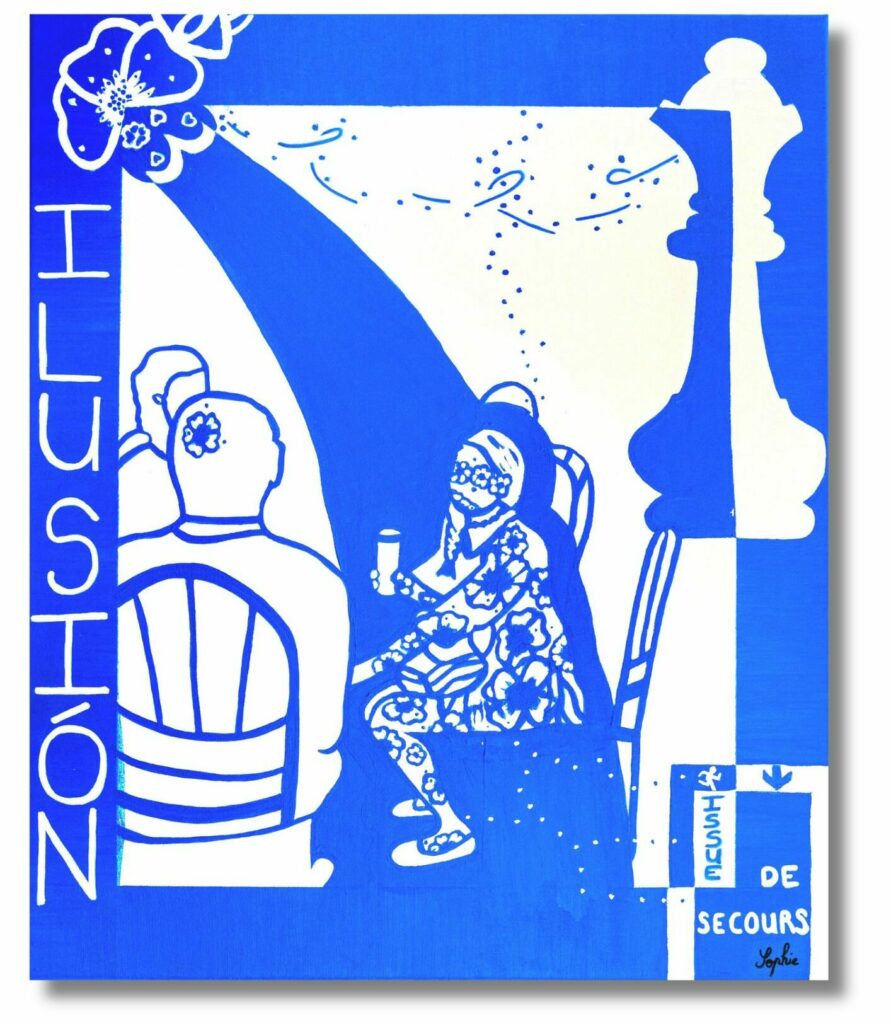
Painting, 50 x 60 cm
July 2023
Ilusión
Text accompanying the painting:
It is so easy to “put on an act“, to play a role in society in order to avoid drawing attention to one’s living conditions. Not necessarily consciously, but as a result of upbringing or avoidance. It can be extremely difficult for a victim to recognize that they are one within a “certain context.” Daily or repeated abuse can often seem “normal” to them, even though it is unlawful and punishable.
If those around the victim recognize the dysfunctional situation in which they are trapped, they can play a fundamental role by talking to them and offering their support. This can take time. Those close to the victim must understand that denial can, in some way, “protect” the victim and that breaking free from it can be particularly difficult.
The victim, meanwhile, may feel extremely alone, hurt, disrespected, and misunderstood if those around them fail to acknowledge the violence they are experiencing, even when they themselves are aware of it.
Read more
Psychological abuse can have consequences just as devastating as physical abuse. The brain does not distinguish between physical and psychological violence; it processes them in a similar way. It is vital not to dismiss either form of abuse and to leave such a situation as soon as possible. There is a way out. “Holding on to life” means never doubting that a way out exists.
Dolores emphasizes that “shame must change sides.”
“Ilusión” means “illusion” in Spanish.

Maison de Justice et du Droit (Legal Advice Centre) in Villeurbanne, since July 2023
Resources
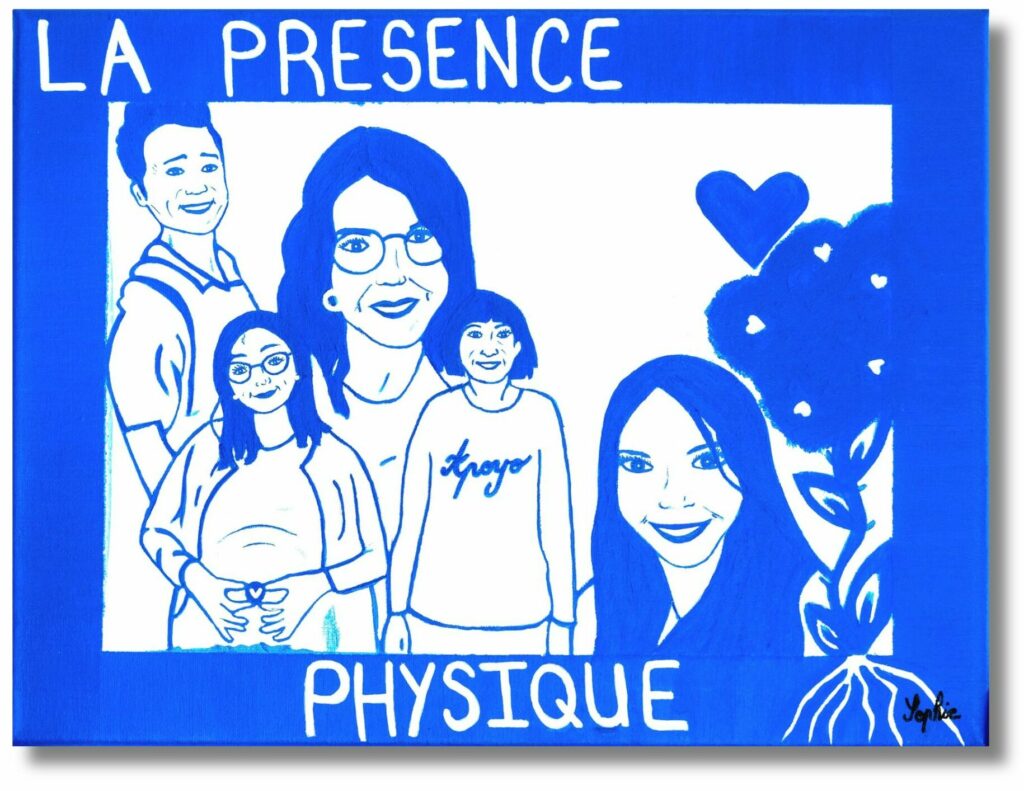
Painting, 30 x 40 cm
July 2023
Apoyo
Text accompanying the painting:
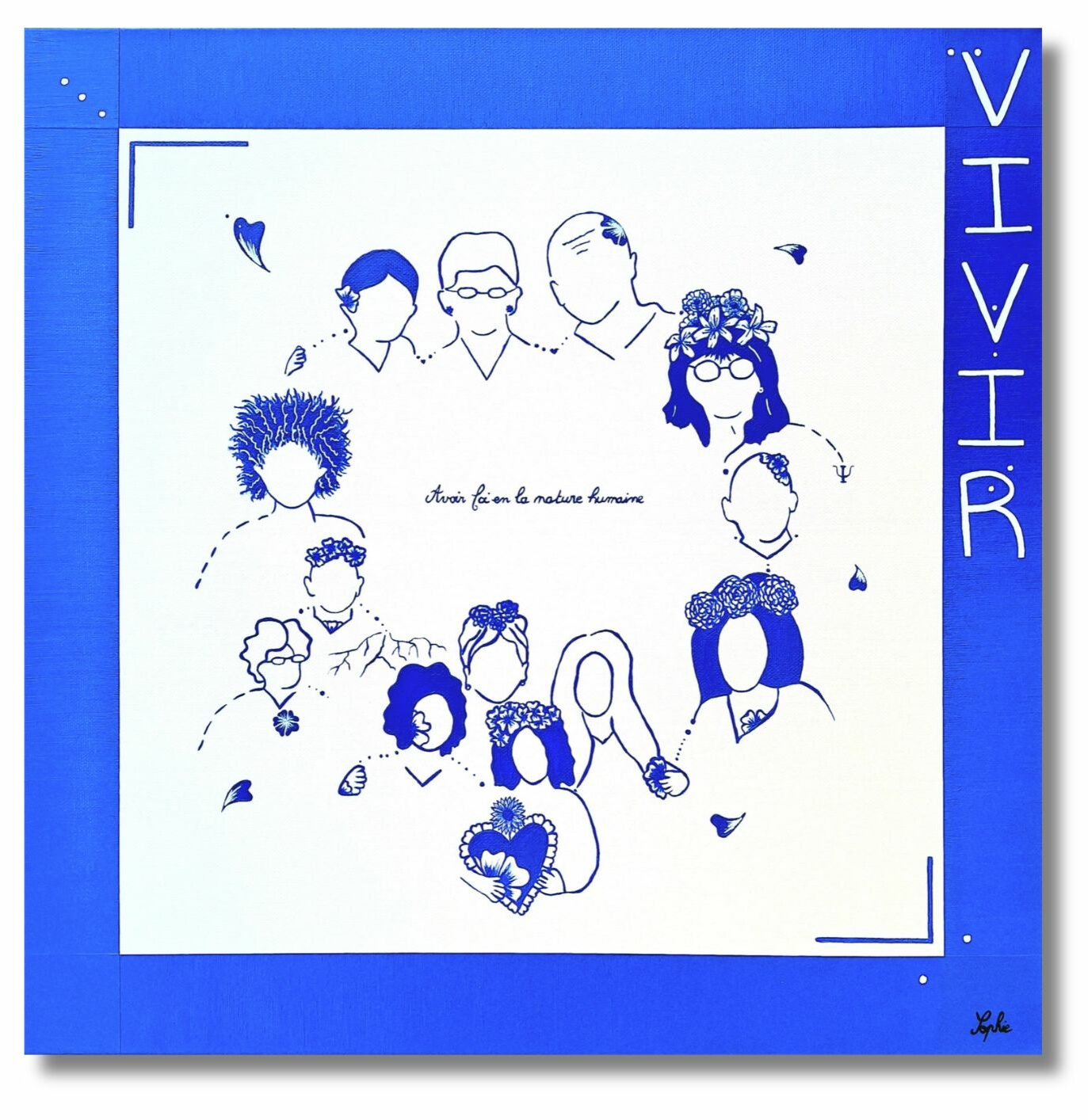
Those close to us often feel useless and powerless when faced with the distress of a child, a parent, a friend, a family member, or a colleague. This situation is not easy for them either, as they also suffer indirectly. Yet loved ones can be the driving force that enables a person in difficulty to persevere through hardship and over time.
People who are suffering may need to withdraw and isolate themselves, but it is essential that some people remain physically present in their daily lives.
Read more
Dolores is infinitely grateful to the loved ones who stayed by her side during her darkest moments. They could never all fit into this painting. Her improved well-being would not have been possible without them. She dedicates her first victories to them.
THANK YOU for being there to help her walk, cook, do household chores, get to all her appointments, come to her home or welcome her whenever she needed it, sleep beside her, support her through her anxiety, answer her calls for help, and stay with her even in silence, throughout these past five years…
She is grateful for their thoughtful gestures, phone calls, messages, letters, care packages, visits, surprises, and thoughts.
Dolores is happy to be able to gradually start living again and sharing moments of happiness with them: festive evenings, activities, weekends, games of pétanque, big announcements, birthdays, weddings, plans and projects, the birth of little Victor, as well as all those simple yet essential moments of everyday life.
A battle fought together. A battle we will win together.
“Apoyo” means “support” in Spanish.
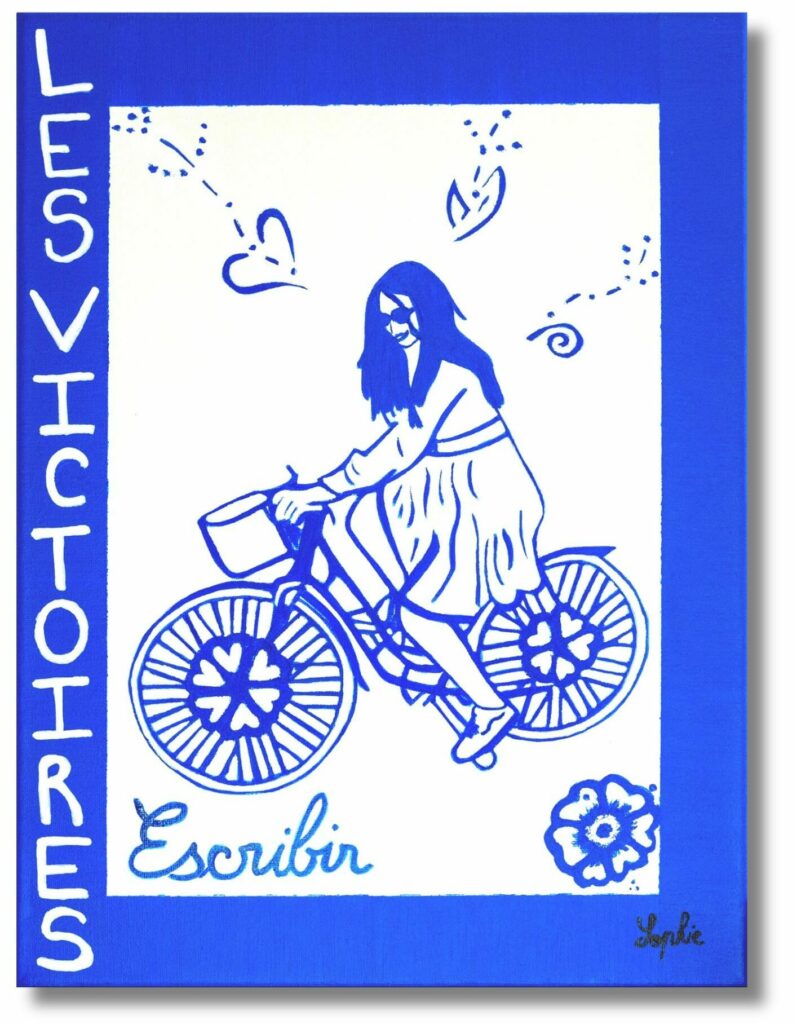
Painting, 30 x 40 cm
july 2023
Escribir
Text accompanying the painting:
Dolores got back on a bicycle for the first time on March 25, 2022! The dates of our greatest victories are never forgotten. What may seem like a “non-event” to some can be an achievement that seems impossible to others.
Everyday life is filled with small and great victories. Dolores has every right to celebrate them. Following the advice of her healthcare professionals, she writes down three positive moments from her day every evening, as well as, of course, all her first achievements. She has been doing this for almost two years, training her brain to focus on the positive — and this method works.
“Escribir” means “to write” in Spanish.
Carers
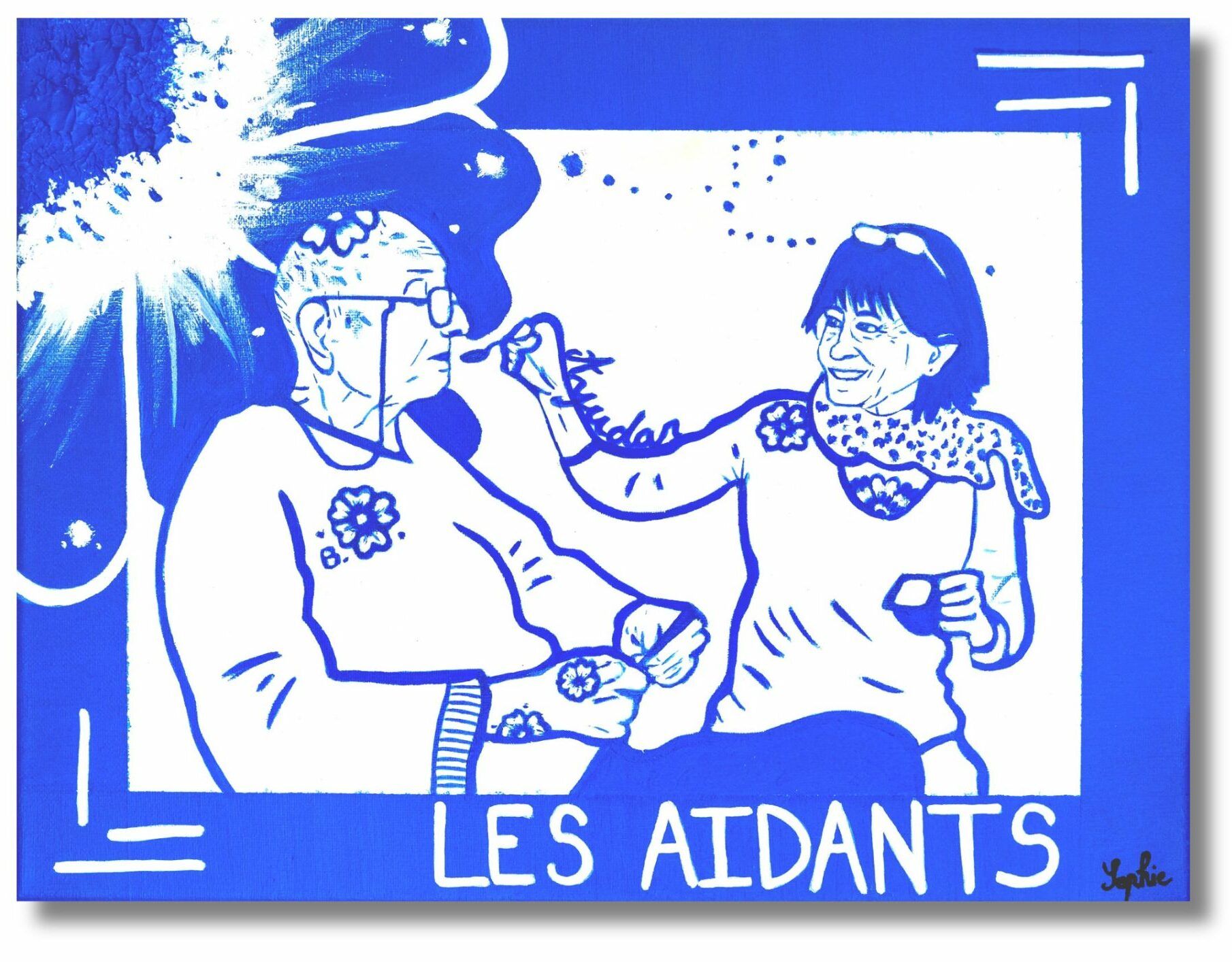
Painting, 30 x 40 cm
October 2023
Ayudar
Text accompanying the painting:
Dolores pays tribute to caregivers who regularly and voluntarily care for people who have lost their independence due to age, illness, or disability. Their presence, support, and assistance are essential to loved ones who struggle with daily life, experience suffering, and are sometimes in distress. No words or thoughts can fully express the value of the help they provide. It is far more than assistance; it is an act of selflessness.
Read more
Beyond intimacy, caregivers share the pain, worries, sorrow, fear, and sometimes isolation. They have the kindness and generosity to accompany their loved ones without expecting anything in return.
Caregivers are everywhere: spouses, children, parents, family members, friends, neighbors, volunteers, colleagues, and others.
They deserve recognition, support, rest, and, above all, the opportunity to look after their own well-being. Thank you for all the energy, love, patience, kindness, and moments of joy you give.
Caregivers need support too.
There are various forms of assistance available, some of which have been established by the government (France). Dolores encourages you to learn more about the daily caregiver allowance, respite care support, tax benefits, financial compensation for providing care to a loved one, training programs, and caregiver support and respite platforms. Administrative procedures can be lengthy and burdensome, but it is important to claim the support and benefits to which you are entitled. You are not alone. Take care of yourself.
“Ayudar” means “to help” in Spanish.
Paintings reserved for the artist
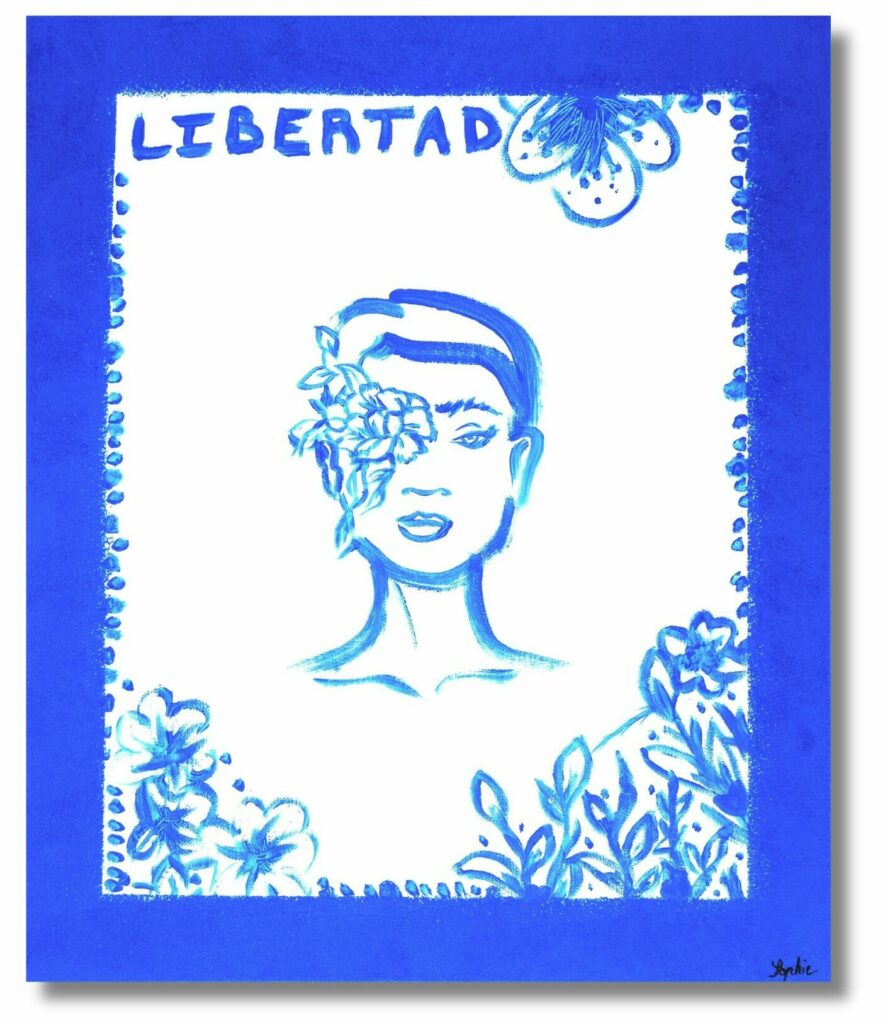
Painting, 65 x 54 cm
December 2022
Libertad
Text accompanying the painting:
Dolores painted this first painting without ever having painted before. She had a visceral need to see the color blue. Unable to find a painting that appealed to her, she spontaneously created this one, inspired by a drawing by an unknown artist. She decided to keep the painting as a reminder of the choice she had made: to acknowledge herself, embrace who she was, and choose freedom. To paint in order to exist.
She replaced her eye pain with flowers. She chose to transform her suffering into beauty.
“Libertad” means “freedom” in Spanish.
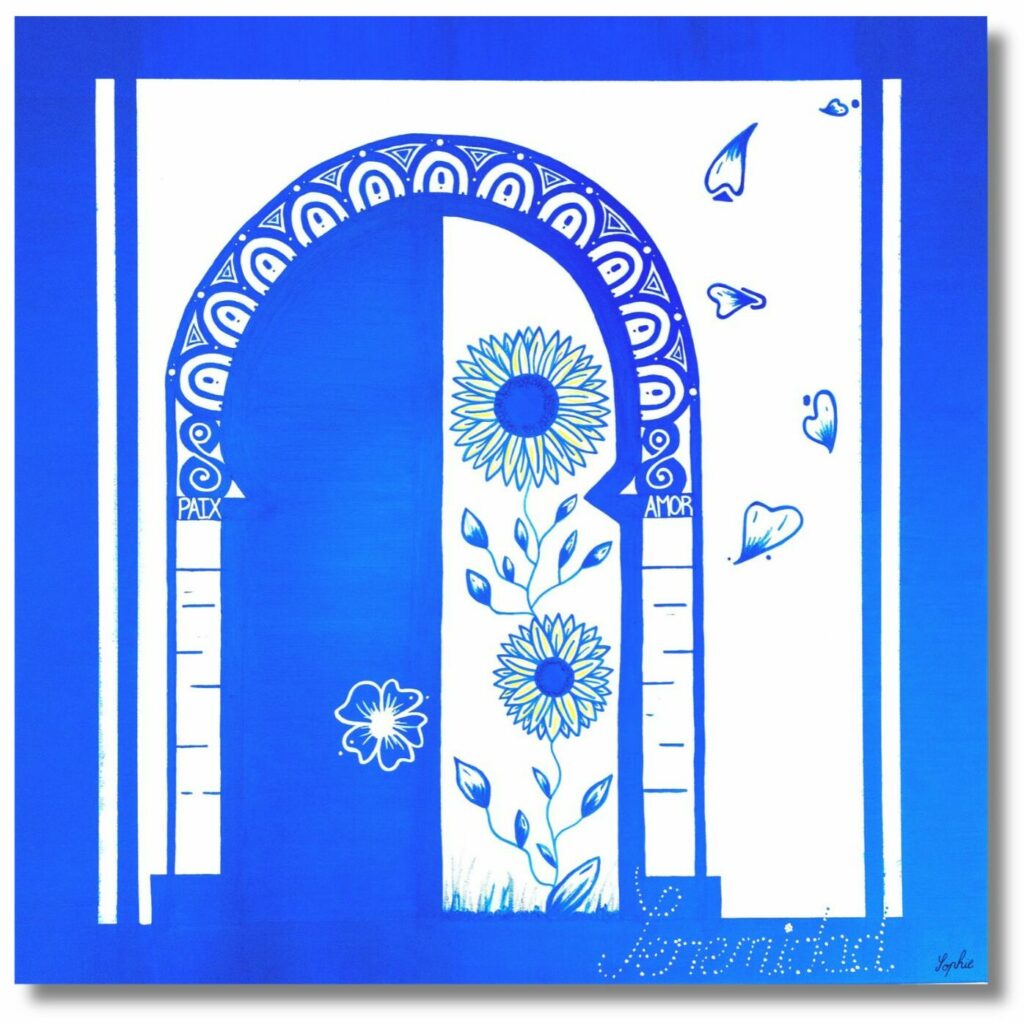
Painting, 100 x 100 cm
December 2022
Serenidad
Text accompanying the painting:
Dolores will take several months to complete this painting, which is intended to decorate her living room. It serves as a daily reminder of what she wishes for herself.
“Serenidad” means “serenity” in Spanish.

Artist’s studio
Relationships
Work in progress since January 2025
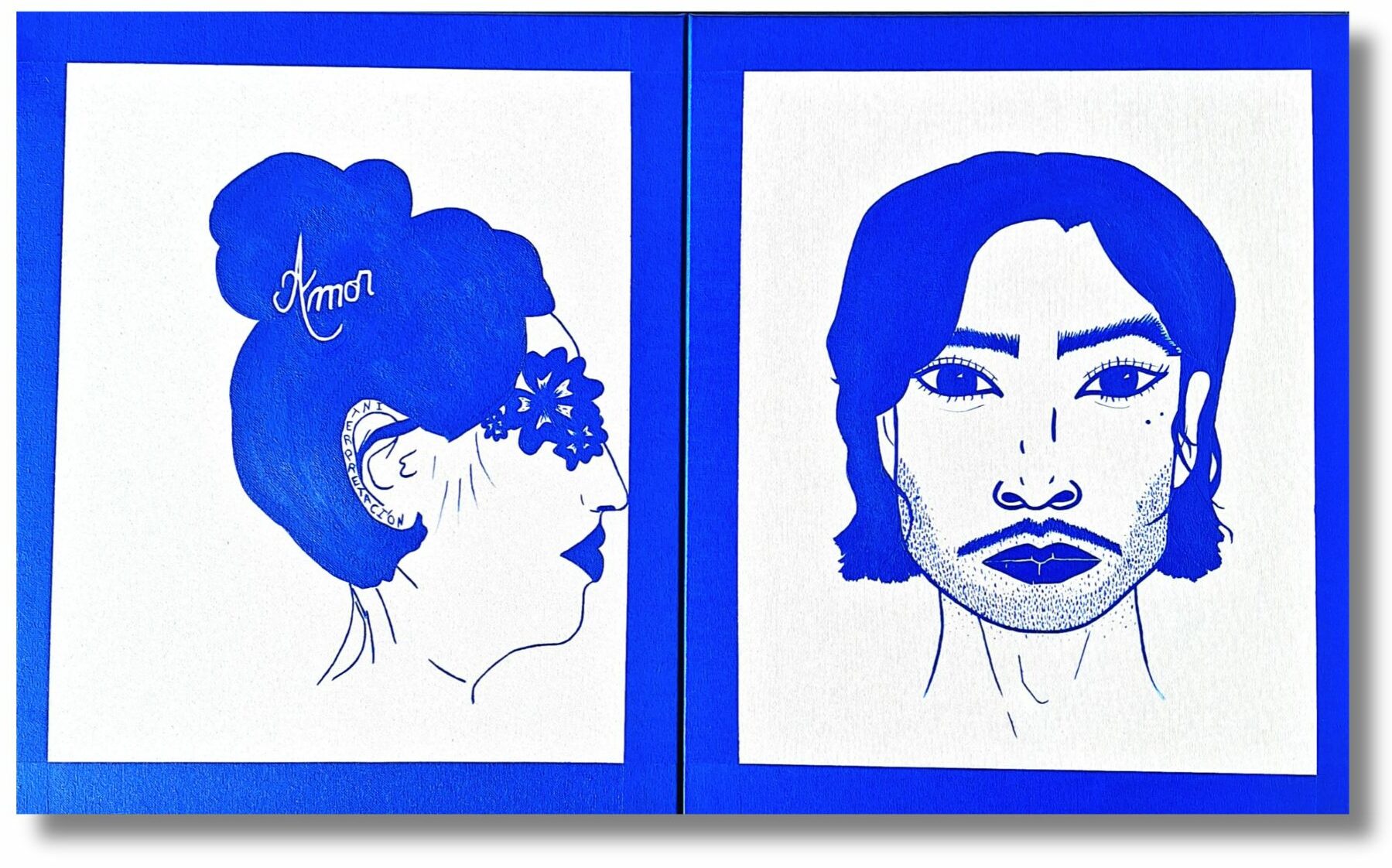
Are you interested in this art project?
Would you like to commission a bespoke piece (the creation of one or more paintings) or organise a temporary exhibition
(rental of several paintings from the Dolores Collection)?

Exhibitions
To give the public the opportunity to discover, share perspectives and discuss issues that affect us all.
Custom orders
A subject you wish to highlight through art, meaningful decoration, or a piece of artwork that symbolises a personal journey…